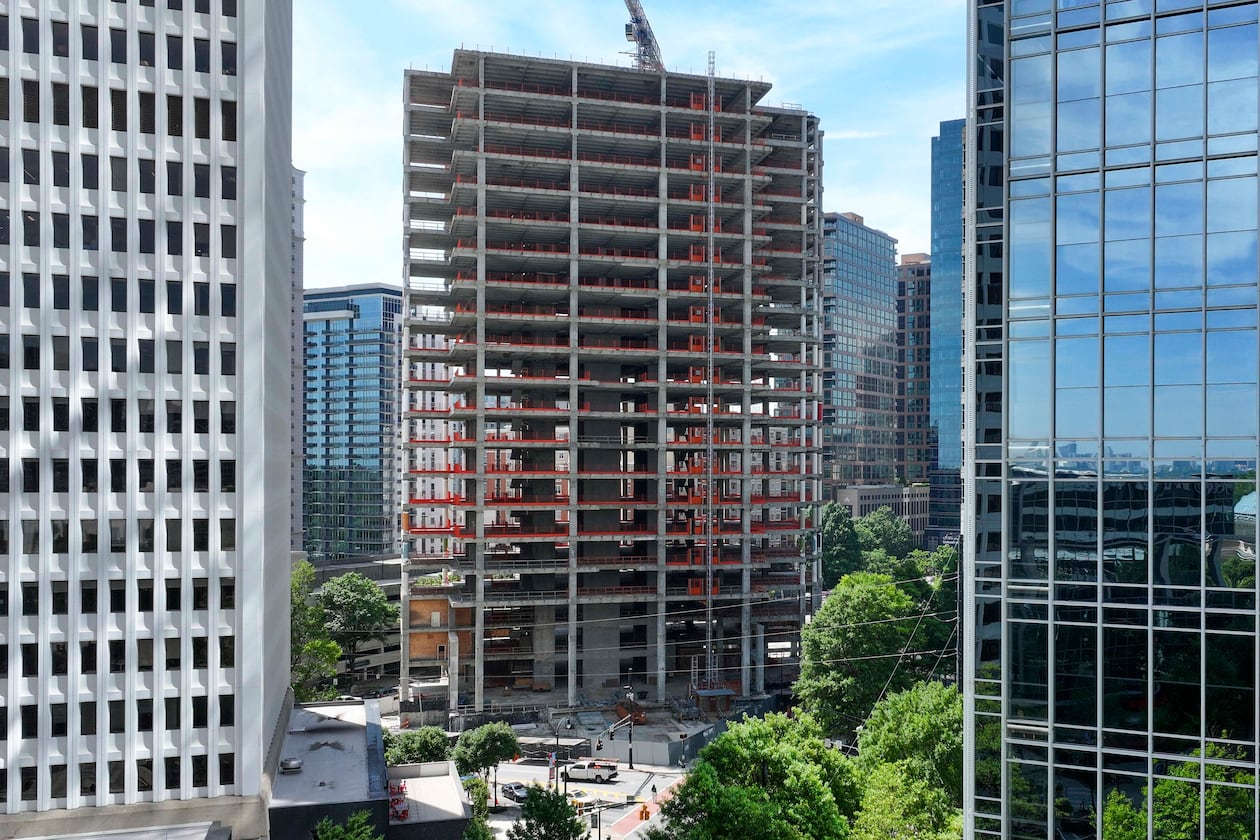
John Dewberry, the developer of the skeletal office tower on Peachtree Street in Midtown, recently warned Atlanta leaders that the city’s efforts to crack down on the long-stalled project and prompt him to move faster has actually put the $430 million proposal in peril.
Residents and city leadership for years have expressed their frustration over the see-through structure and, more recently, the crane hovering over the site at Peachtree and 14th streets.
In May, the city’s Department of Planning and Community Development posted a sign at the site that said it was unsafe because of an allegedly unsecured construction barrier, a warning that has since been taken down. The following month, the City Council urged the city to impose a blight tax to prod Dewberry into action or to sell the building he calls The Midtowne.
In a letter to the City Council dated June 25, Dewberry said press generated by a “politically motivated” decision to call for the blight tax has put the project in “critical condition,” and could have “potentially grave legal consequences.”
“City Council might as well take a wrecking ball to The Midtowne and any chance of its completion, and as a result hurt the very constituents and neighbors City Council believes its (sic) aiding,” Dewberry wrote.

Credit: J. Scott Trubey
Credit: J. Scott Trubey
The Atlanta Journal-Constitution was sent the letter by a Midtown resident, who obtained it through an open records request. Two council members confirmed receiving it, though both declined to comment on it. Dewberry also sent council members a 19-page presentation on The Midtowne, which the AJC obtained.
Mayor Andre Dickens’ office did not respond to requests for comment. Dewberry and his wife, Jaimie, who is an executive and acts as his spokesperson, also did not respond to emails, calls and text messages.
In the nearly three months since sending the letter, it is unclear if the financial difficulties Dewberry described have changed.
But the letter provides a rare glimpse into Dewberry’s challenges in finishing the tower, which has been under construction for more than six years.
In recent years, development has continued around the tower. The owners of the neighboring Colony Square completed a $400 million reimagining of the Midtown landmark, while the new owners of the neighboring Proscenium tower have overhauled the building and added well-known tenants to its roster.
But not all projects are alike. The office market has been challenged in recent years, as financing for new towers has become difficult to find and vacancies have climbed in existing buildings.
Shlomo Chopp, managing partner of Case Equity Partners in New York, said both Dewberry’s letter and the city’s actions dance around the economic realities at play for office projects.
“When you allow for development, you have to allow for these things to happen,” Chopp said. “And when you’re a developer, you have to allow for these things (setbacks) to happen.”
He said both sides still have questions left to answer. For the city, does the blight tax accomplish the goal of prodding Dewberry to restart construction? And for Dewberry, is this blight tax truly preventing him from getting financing, or does funding not exist in the market already?
Henry Lorber, a distressed real estate expert with Henry Lorber and Associates, similarly said, “I wonder if this letter is a play for time.”
‘Stable and safe’
Dewberry announced in 2010 he was acquiring the building, long known as Campanile and once BellSouth’s headquarters, for $36 million.
For years under his ownership, it was a functioning office tower, home to such tenants as Pandora and SunTrust, with Dewberry investing millions modernizing the tower.

Credit: Stell Simonton
Credit: Stell Simonton
In 2019, Dewberry launched an ambitious overhaul, with plans to add six floors to the top of the tower, clad it in white marble and install a curtain wall with glass. He’s also proposed a seven-story podium around the base of the structure spanning more than 100,000 square feet to be filled with retailers and restaurants. According to plans included in the presentation, the total office space would reach 703,000 square feet.
But the renovation work slowed in 2019, which was caused by several factors, including a disagreement over price estimates with the former general contractor, Dewberry told the AJC in 2021. And then there was the pandemic, which threw off construction timelines for a number of real estate projects across Atlanta, and dramatically changed pricing estimates to complete them.

Credit: J. Scott Trubey
Credit: J. Scott Trubey
From the outside, it appears as though little visible progress has been made on the tower. Dewberry argues otherwise in his letter. His team removed 6,000 tons of building material from the former office structure. Dewberry wrote his team has driven 200 pilings in the lowest level of the building’s parking deck and prepared the concrete core to accept future structural concrete, two tasks “nearly impossible to view as it occurs under building or at core (elevator) areas,” he wrote.
He said the public, lenders and others have been “lead (sic) to believe The Midtowne would soon disintegrate,” contending that, with the structural work done, “a more stable and safe structure would be hard to locate” in the U.S.
District 2 Councilmember Kelsea Bond learned in July that some of the expired permits at the site were renewed by the Department of City Planning because there was construction going on underground, they told the AJC in an email.
Dewberry wrote he also has had conversations with several tenants, including luxury gym operator Equinox and Doha, Qatar-based Japanese restaurant Zuma. The presentation also included coworking operators Convene and The Malin, as well as workout studio Oblix as potential corporate tenants. A Convene spokesperson said the company is “not in active conversations regarding a Midtowne venue in Atlanta,” while the other four businesses did not respond to requests for comment.
The demolition work cost millions of Dewberry’s own money, he wrote. He’s putting $130 million of his personal equity into the project, he wrote, about $55 million of which represents design, demolition and structural work, among other line items. The total project cost is $430 million, he said, but described The Midtowne as a “$billion (sic) dollar project.”
“Not sure how one spends $130 million on a building and it is deemed abandoned, blighted or vacant — impossible!” he wrote.

Credit: J. Scott Trubey
Credit: J. Scott Trubey
‘We lose financing, we lose tenants’
Since Dewberry began the renovation, the real estate cycle has changed. Construction boomed as interest rates were lowered in the aftermath of the pandemic, though the Federal Reserve rapidly raised its benchmark rate in response to inflation, hitting real estate hard. Values peaked in 2022 before declining 22% over the following two years, according to investment giant Blackstone.
In Atlanta, new office space flooded the market, as new towers came out of the ground after the pandemic or were dramatically renovated. Financing for new office projects, both in Atlanta and nationwide, became extremely difficult to find, or, as Dewberry writes in the letter, “is somewhere between non-existent and extinct” outside of New York.
Dewberry said in the letter that he has searched everywhere, including the U.S., Europe and the Middle East, for the funds required to complete the project.
In October of last year, the office tower’s existing first mortgage lender, Acore Capital, “intimated” that if The Midtowne LLC paid off its existing $75 million mortgage, a separate fund would favorably consider financing the final funds required, Dewberry said in the letter. That would be a $100 million senior mortgage.
He said in the letter that he paid off the $75 million loan in February 2026. A quitclaim deed filed in February indicates the lender returned the title to Dewberry, according to a report by Bisnow. After pushing Acore for a definitive yes or no on the senior note approval, it said the noise associated with the crane above the tower, the blight tax and unsafe site warning “caused executives to walk,” he said in the letter.
The AJC also could not independently corroborate this or the Acore communication. The firm did not respond to a request for comment.

Credit: J. Scott Trubey
Credit: J. Scott Trubey
Another lender he was working with — Bayview Asset Management — also said it was “very concerned,” Dewberry wrote. The group issued a term sheet last July for $200 million, he said. Bayview declined to comment.
“We lose financing, we lose tenants,” Dewberry wrote. “We lose tenants, we lose financing!” calling the project “D.O.A.,” written in red and in all-caps, if Bayview is lost.
Commercial real estate observers who spoke to the AJC said they did not see an easy path forward.
“I don’t know if I ever see this happening,” said Lorber, the distressed real estate expert.
About the Authors




Keep Reading

The Latest

Featured