


Republican U.S. Rep. Mike Collins enters the general election facing a challenge that goes beyond winning over swing voters: convincing Republicans in Georgia and Washington that he can defeat Democratic U.S. Sen. Jon Ossoff.
The GOP nominee trails in early polls, faces a massive fundraising disadvantage and carries the sort of political baggage that his rivals long warned could doom him in November against a rising Democratic star.
That leaves Collins fighting on two fronts. He must broaden his appeal beyond the Trump loyalists who powered his June runoff victory while also convincing donors, activists and national strategists that Georgia remains worth their resources.
It is a far different task from the one Collins faced in the primary, when he built his campaign around loyalty to President Donald Trump to defeat former football coach Derek Dooley, who — along with Gov. Brian Kemp — argued Collins could never win the middle of the electorate.
For now, Washington Republicans are signaling they’re not going anywhere. The Senate Leadership Fund, the GOP’s most powerful Senate super PAC, announced a $44 million investment in April. And other Republican heavyweights say they’re committed to the race.
“Jon Ossoff is the most vulnerable Democrat Senator on the map,” said Nick Puglia of the National Republican Senatorial Committee, who said Collins is “delivering for hardworking Georgians.”
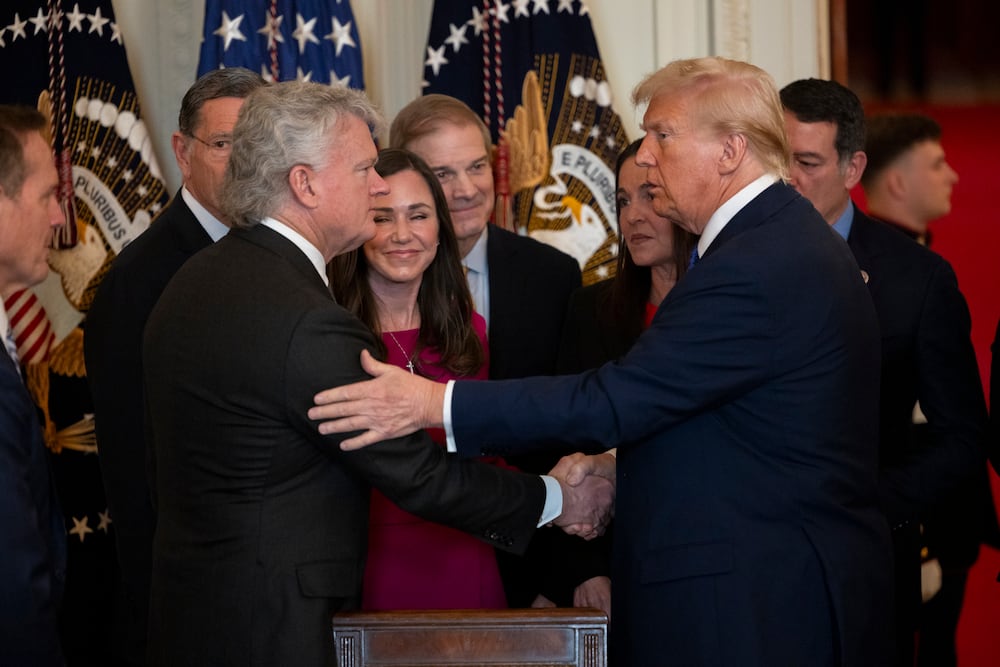
Trump is likely to reinforce that message this week when he travels to Georgia to appear alongside Collins at Wheeler High School in Cobb County, their first public event together since the runoff.
But the public show of confidence hasn’t quieted longstanding doubts about Collins’ chances of ousting Ossoff. Now those concerns are mounting.
“This is even worse than I could have imagined,” said Jay Wells, a veteran Republican activist from southwest Georgia. He predicted a defeat even more lopsided than Republican Herschel Walker’s 2022 loss to U.S. Sen. Raphael Warnock.
“Mike Collins should have never made it out of the primary,” he added.
Ed Henderson, a longtime member of the Georgia GOP’s state committee from Rabun County, said an expanding map of competitive Senate races could make Collins’ task even harder.
“The Georgia Senate race has been eclipsed by more pressing races for both parties,” he said. “Sure, the NRSC will make a nominal contribution to Collins, but Donald Trump has put too many other races in play.”
Ossoff is hardly acting like a safe incumbent. He warns supporters that tens of millions of Republican dollars are still headed to Georgia, a message that helps keep his fundraising churning and wards off complacency. And he frames his campaign as a referendum on Trump.
“We won’t just restore checks and balances for the next two years,” Ossoff told supporters in Rome on Friday. “We will rebuke him so decisively that no president will dare try this type of brazen corruption and abuse again for centuries.”
‘Crystal clear’
After Trump recaptured Georgia in 2024, Ossoff was considered his party’s likeliest Senate casualty. Republicans dreamed of rallying behind Kemp, while Democrats braced for a brutal fight in the only state Trump carried with a Democratic Senate incumbent on the 2026 ballot.
Kemp passed on the race and the Republican field splintered. Ossoff, meanwhile, rebuilt a financial juggernaut, engineered an overhaul of the state party’s leadership and positioned himself as a leading antagonist of Trump. By last year, Republicans were already sounding the alarms.

Credit: Sarah Peacock
Credit: Sarah Peacock
The last few weeks have only heightened the concerns. Ossoff has led in every public survey since April 2025, including a Fox News poll that showed him with a 56-43 edge over Collins. The same poll showed a majority of voters were concerned Collins was too close to Trump.
Then there is the financial chasm. Ossoff entered the general election with more than $42 million on hand after raising $20 million in the second quarter. Collins begins the general election with about $2 million in his account.
Collins and his allies say the race is only beginning. He has upcoming fundraisers scheduled with Senate Majority Leader John Thune and U.S. Sen. Tim Scott, the NRSC chair. And he is sharpening his case against Ossoff, casting the Democrat as “weak, woke and running scared from his radical liberal record” — and powered by out-of-state donors.
Collins also enters the general election campaign with a ground-game network that was the envy of his GOP rivals. He plans to use it to court two distinct groups: Trump supporters who fueled his runoff victory and swing voters he believes will respond to his congressional record.
“We’ve just begun to compare resumes. It’s as easy as that,” Collins said. “The choice in this race couldn’t be more crystal clear.”
But a measure of despair is seeping in. Even U.S. Rep. Buddy Carter, the race’s third-place finisher, acknowledged on SiriusXM that Collins was “way behind” and warned that a poor showing could be a “drag at the top of the ticket.”
He later tempered his comments in an interview, emphasizing his support for Collins.
“It’s still early,” he said, “and polls will change and that race is going to tighten.”
A familiar Trump test
The challenge for Collins isn’t just the polling or the money. It is the political brand that helped him win the nomination.
Ossoff decided early to cast the race as a referendum on Trump. But he is also taking the contest into deeply personal territory. Minutes after Collins clinched the nomination, Ossoff branded him a “notorious bigot, antisemite and extremist” and released a video portraying him as a scandal-shadowed Trump lackey.
Credit: Nathan Posner for the AJC
Credit: Nathan Posner for the AJC
He’s trying to exploit what Democrats see as a central vulnerability: Collins has little room to distance himself from an unpopular president.
Billionaire Rick Jackson, the GOP nominee for governor, spent the primary promising to be Trump’s “favorite governor.” Yet Jackson opened his first general election rally with a 19-minute speech that focused on his opponent and sidestepped any mention of Trump at all.
Collins can’t make the same pivot without piercing the brand that carried him this far. He built his political identity around being one of the president’s fiercest allies. Just days after his runoff victory, he repeated the false claim that Trump won Georgia in 2020.
‘It’s unpredictable’
That tight embrace of Trump isn’t Collins’ only November vulnerability.
The House Ethics Committee is reviewing allegations that Collins’ office misused taxpayer funds, including claims that his former top aide, Brandon Phillips, performed campaign work while drawing a congressional salary and arranged a paid, no-show internship for his girlfriend. Collins has called the complaint a “nothing burger.”
Collins later cut ties with Phillips after his campaign account posted a vulgar attack involving the wife of a Dooley strategist.
Phillips’ successor, Kip Talley, attracted scrutiny after Slate reported he told friends he would use “the levers of the legislative branch” to help a Holocaust denier secure his release from prison. Collins has since hired his third chief of staff in a year.

Credit: Arvin Temkar/AJC
Credit: Arvin Temkar/AJC
The latest controversy involved a family member rather than an aide. CNN reported that his son-in-law posted white nationalist propaganda, Nazi imagery and antisemitic conspiracy theories on social media. A Collins aide later said he condemned the posts.
Each episode gives Ossoff new material and reinforces the argument Kemp and Dooley made during the runoff that Republicans needed a political newcomer without a long record.
Or as Erick Erickson, a conservative commentator, AJC contributor and critic of Collins, put it on social media:
“I told you guys the scandals for Collins would pile up.”
Interviews with a dozen Republican voters at a campaign event last week in north Georgia reflected a mix of confidence, doubt and resignation about Collins’ chances.
“People like me don’t answer polls. There are a lot of people who aren’t paying attention. It’s too early to fret,” said J.J. Jorgensen of Dahlonega.
Habersham County GOP Chair Carl Blackburn was equally upbeat.
“The polls have been wrong before. I’m still optimistic. He’s done what he needs to do,” Blackburn said. “We think that his message will carry through all of Georgia and we’re very confident he’ll pull it out.”
But David Brookins of Blairsville was more pessimistic.
“I’m voting for Mike Collins, but I think Ossoff is going to win,” he said. “I feel like Republicans have ignored that race. The RNC should have been down here a year ago.”
Even so, he said it was far too early to count Collins out.
“The one thing about politics is, it’s unpredictable.”
Washington bureau chief Tia Mitchell contributed to this report.

Credit: Miguel Martinez/AJC
Credit: Miguel Martinez/AJC
About the Author




Keep Reading

The Latest

Featured
