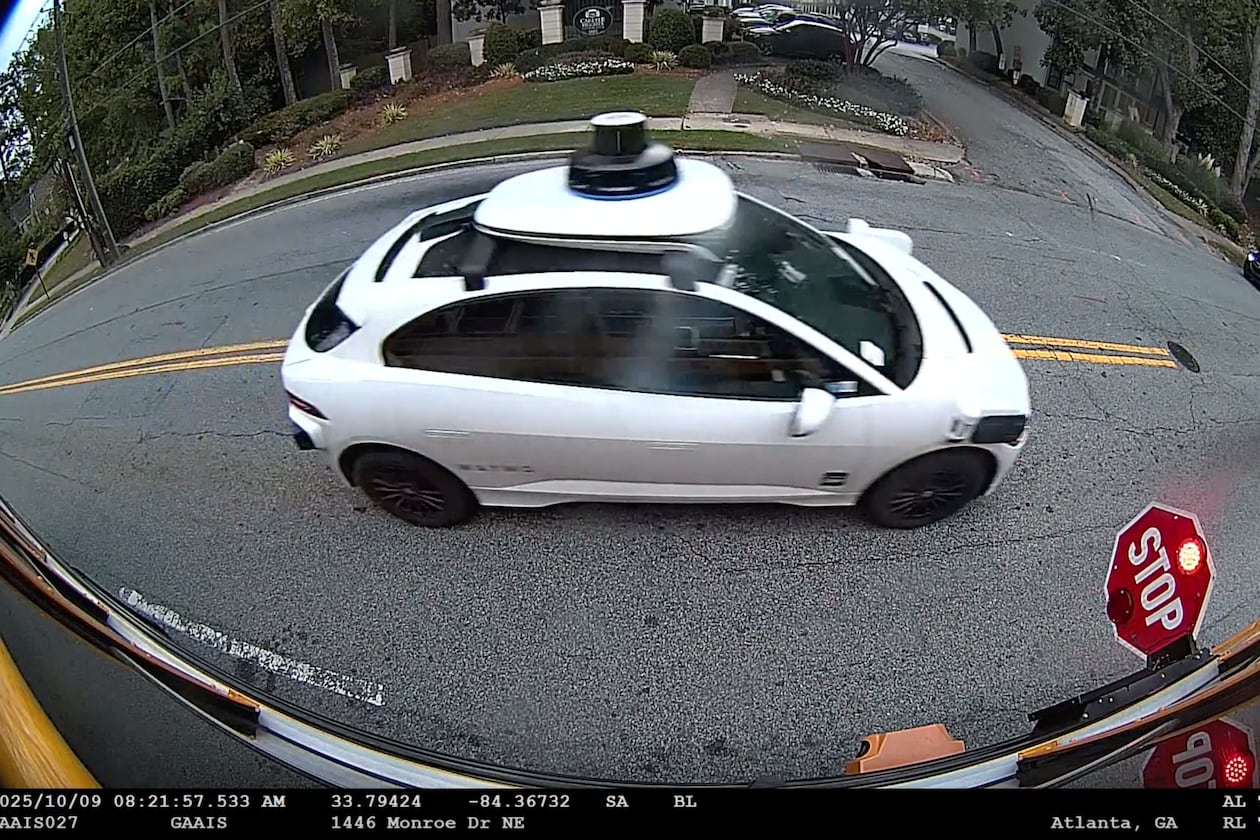
A disturbing pattern of driverless cars rolling past stopped school buses has revealed a new kind of dilemma on Atlanta’s streets.
Since May, Atlanta Public Schools has reported six cases in which Waymo’s autonomous vehicles drove past school buses with their stop arms extended, most recently on Nov. 11. No injuries have been reported, district spokesperson Seth Coleman said, but the instances are dangerous for kids loading and unloading.
Such incidents in Atlanta and other states led to the National Highway Traffic Safety Administration recently opening an investigation and Waymo issuing a “voluntary software recall” Monday.
Waymo isn’t going anywhere, though. The fleet — consisting mostly of white Jaguar I-Paces clearly identified by their countless cameras — will continue traveling through parts of the city.
In a statement to The Atlanta Journal-Constitution, the company said the software updates implemented Nov. 17 were designed to address cases in which vehicles slowed or stopped but then continued past stopped school buses, and that additional fixes will apply if needed.
“While we are incredibly proud of our strong safety record showing Waymo experiences 12 times fewer injury crashes involving pedestrians than human drivers, holding the highest safety standards means recognizing when our behavior should be better,” Waymo’s chief safety officer, Mauricio Pena, said via email.
“As a result, we have made the decision to file a voluntary software recall with NHTSA related to appropriately slowing and stopping in these scenarios. We will continue analyzing our vehicles’ performance and making necessary fixes as part of our commitment to continuous improvement.”
An investigation and subsequent recall
The recall, which “potentially” involved just over 3,000 vehicles, comes on the heels of an NHTSA investigation opened Oct. 17. Public records show the agency notified Waymo about the investigation Dec. 3 and acknowledged the recall Thursday.
According to the NHTSA, its Office of Defects Investigation identified a report of an autonomous vehicle failing to remain stopped for a school bus that displayed flashing lights and a deployed stop arm while students disembarked. The agency did not clarify where the incident took place.
Because Waymo’s vehicles travel about 2 million miles per week, the NHTSA concluded that similar incidents likely have happened before.
The investigation specifically aims to address how Waymo’s Automated Driving System performs around stopped school buses and complies with school bus traffic safety laws.
The NHTSA said it does not pre-approve new technologies or vehicle systems, but manufacturers certify that their vehicles meet the agency’s safety standards.
“The agency investigates incidents involving potential safety defects and non-compliances with NHTSA standards and will take any necessary actions to protect road safety,” a spokesperson told the AJC via email.
Video obtained by the AJC of the six incidents in Atlanta shows a Waymo crossing a double yellow line at least three times to go around a school bus, and slowing or briefly stopping but continuing on its path in the other scenarios.
The DeKalb County School District confirmed it has not received any similar reports.
Included in the same investigation was the Austin Independent School District in Texas citing 19 instances of a Waymo vehicle “illegally and dangerously passing” a school bus as of Nov. 19, according to an email from that school district to Waymo.
The law is complicated
Waymo launched a limited number of autonomous vehicles in Atlanta in June 2024 and expanded by early 2025. The vehicles operate across 65 square miles inside I-285, which includes parts of Atlanta and DeKalb County, from Buckhead to Druid Hills to West Midtown to downtown to just north of Hartsfield-Jackson Atlanta International Airport.
Georgia law is murky when it comes to holding driverless vehicles responsible for traffic violations. State law does not identify Waymo or an autonomous vehicle as a driver, only that an automated driving system is allowed to operate without a human driver.
Drew Ashby of the Ashby Thelen Lowry law firm in Marietta argues Waymo itself is the driver. The company can be fined similarly to how a human driver is fined for passing a school bus, but $1,000 might not make an impact, Ashby explained.
Ashby, who represents clients injured in crashes, said it’s possible to hold a corporation like Waymo accountable.
“A traffic citation is a misdemeanor, it is a crime, albeit low level. Waymo could absolutely be ticketed for these things as the driver. … The complications from that would be whether the solicitor or the assistant district attorney or whoever is assigned to that sort of case would want to go through the level of complexity that will take,” Ashby said, adding that “the complexities of the system could prevent and even frustrate the ability to hold this company accountable for the mistakes and crimes that are committed by the software that it created.”
Atlanta police confirmed to the AJC they review all school bus and zone violations and have issued six “Notice of Violations,” which include a $1,000 fine, to Waymo LLC for improperly passing Atlanta Public School buses. These differ from a traditional ticket a driver would get if pulled over because they are mailed to Waymo.
The Atlanta Police Department’s policy states that because the court system is currently unable to process traffic citations for autonomous vehicles, if the vehicle breaks a traffic law, an officer is present and a citation is warranted, the officer instead must write a report detailing the circumstances. That special policy went into effect in May and outlines ways for officers to contact a Waymo representative in certain situations.
Other states are ahead of Georgia. Arizona law clarifies that an automated driving system is considered the driver for the purposes of traffic compliance.
“There are numerous different ways for these vehicles to see what’s ahead, and there are far fewer ways for them to know what’s ahead. … It can sense and see anything it wants, (but) how it knows what that is and how it responds to that is a completely different set of criteria that are embedded in software that’s written by humans who are fallible,” Ashby concluded.

Credit: Ben Hendren
Credit: Ben Hendren
Waymo has faced previous issues
In a news release, Waymo said it has “built an incredibly advanced AI system safely operating in the physical world at scale.” The company added its technology learns from simulations of “challenging scenarios, including potential collisions, inclement weather, intricate intersections and unusual behaviors on the road,” and by analyzing driving logs.
Since 2024, Waymo has issued three other recalls.
The most recent was in May of this year after certain vehicles with software versions released before Nov. 7, 2024, were colliding with roadway barriers, such as chains and gates, according to the NHTSA. The company said it updated the software by Dec. 26, 2024.
The two other recalls involved vehicles failing to avoid poles or similar objects and inaccurately predicting the movement of towed vehicles, documents on the NHTSA site reveal.
It’s also the second time the NHTSA has investigated Waymo. The agency identified 367 incidents during the first investigation, which was opened in May 2024 and closed in July 2025, with 109 crashes. NHTSA said the vehicles were crashing into stationary and semi-stationary objects, displaying unexpected responses to traffic control devices and entering construction zones.
— Staff writer Samantha Hogan contributed to this article.
About the Author


Keep Reading

The Latest

Featured